

My Trading > My Trading Journal > July 8, 2012
My Trading Journal
July 8, 2012
9:44 pm (PST)
Sometimes it is good to calculate the value of a company just to practice your valuation skills. Although I typically don't care much about high-profile stocks or IPOs that have received a lot of attention, sometimes I like to look at them out of curiosity. Facebook is an obvious example because of its hype. Here is a quick back-of-the-envelope calculation of the value of Facebook stock using my valuation process.
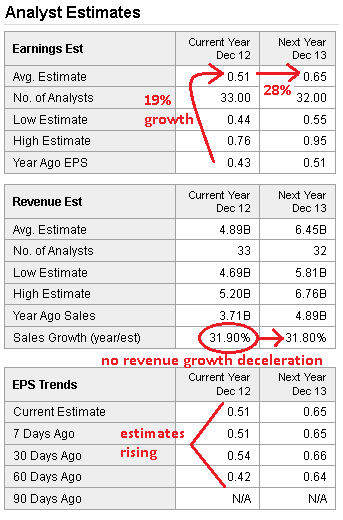
The first step I do is create a base of earnings to apply a P/E multiple to. Since we are halfway through 2012, the earnings estimates for the full calendar-year 2012 earnings will do. They are $0.51. If today's date were close to the end of the year, I would probably use a blend of 2012 and 2013 earnings estimates.
The second step I do is calculate the P/E ratio to multiple against the just-calculated earnings. This is a multi-factor subjective process.
The first thing I look at here is the revenue growth rate. This year's revenue growth is 31.9% and next year's growth rate is 31.8%. By combining these, I come up with a blended revenue growth rate of about 32%. If their revenue growth rate decelerated a lot into next year (say, from 31% to 15%), it would be a lot harder to come up with a blended growth rate.
The second thing I look at is the earnings growth rate. With an internet company like Facebook, I expected that the earnings growth rate would be larger than the revenue growth rate based on the assumption that the company would possess economies of scale. I am somewhat surprised to see that the earnings growth rate is lower than the revenue growth rate. This is somewhat understandable though, since Facebook probably ran on more of a shoestring financial budget in the old days and has since scaled their employees very quickly. Although the earnings growth rate for this year is only 19%, next year's growth rate of 28% is much higher - and closer to its revenue growth rate of 31%.
I blended the revenue and earnings growth rate together using a weighted average to come up with the P/E ratio. I weighted next year's earnings more than this year's since that number matters more and seems more representative of its growth. I multiplied the revenue growth rate by 3 in order to give it the same weight as earnings growth. I came up with a multiple of 28.5. See below:
- this year's earnings growth rate (19%) times 1
- next year's earnings growth rate (28%) times 2
- revenue growth rate (32%) times 3
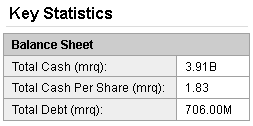
Next, I add the amount of net cash per share to the value. Facebook, as you can see in Yahoo Finance's numbers above, has $3.91 billion in gross cash. When you subtract the $700 million of debt, the $1.83 in gross cash per share gets lowered to $1.50 net cash per share. When we add this $1.50 to the previous value of 17.09, we come up with $18.59.

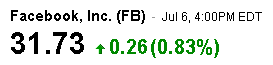
Although the technical picture of a stock doesn't influence the fundamental analysis of a stock, it sometimes helps to see whether a stock is at the higher or lower end of its recent trading range in order to see if a stock's current valuation is at an abnormally high or low level relative to its historical valuation. In the case of Facebook, the stock is trading in the middle of its (admittedly-brief) historical range. So there is no reason to adjust its valuation because of it being in a technically overbought or oversold level.
Conclusion:
At 31.70, Facebook stock is overvalued by roughly 70%. It should be noted that this is just a fundamental valuation of the stock, and not a prediction of the stock. I don't know where the stock will be going and that is not the purpose of this post.
Notes:
Although the point of this exercise was not to get into a comprehensive analysis of the various subjective issues that affect Facebook's stock value, I might as well point out a few since I am already on the subject:
- The estimates of their revenue growth may be inaccurate ecause their revenue growth rate does not show deceleration. Since Facebook's revenue is close to $5-$6 billion, they are getting to the size where they should be showing deceleration in growth. But they aren't. I wouldn't be surprised if they announced an earnings revision for 2013 later this year based on slower-than-expected growth. The main counterargument to this point is below.
- Their ability to monetize their website will increase. Facebook initially concentrated on building traffic without monetizing the user experience and turning users off. But their ability to monetize their traffic is getting better, and will probably just increase in the future as they find new profit channels (games, gambling, whatever).
- The market generally assigns higher P/E ratios to internet stocks. Stocks like AMZN seem to be perpetually over-valued. Facebook may be this kind of stock. So even though it is overvalued by roughly 70%, this premium may be based on secular over-valaution rather than temporary over-valuation.
Journal Entries
- (Journal home)
- (All entries)
- (Latest entry)
- October 27, 2015
- September 14, 2015
- September 13, 2015
- August 13, 2015
- December 28, 2013
- October 27, 2013
- October 4, 2013
- August 28, 2012
- August 24, 2012
- August 23, 2012
- August 22, 2012
- August 21, 2012
- August 20, 2012
- August 19, 2012
- August 5, 2012
- July 8, 2012
- February 8, 2012
- February 5, 2012
- February 2, 2012
- February 1, 2012
- January 31, 2012
- January 30, 2012
- January 27, 2012
- January 26, 2012
- January 25, 2012
- January 24, 2012
- January 23, 2012
- January 20, 2012
- January 19, 2012
- January 18, 2012
- January 17, 2012
- January 16, 2012
- January 13, 2012
- January 12, 2012
- January 11, 2012
- January 10, 2012
- January 9, 2012
- January 6, 2012
- January 5, 2012
- January 4, 2012
- January 3, 2012
- December 30, 2011
- December 29, 2011
- December 28, 2011
- December 27, 2011
- December 26, 2011
- December 23, 2011

